PSA adds biological context
PSA can rise for reasons other than cancer. Some significant cancers occur below commonly used PSA thresholds.
 LONGEVITYPlan your visit
 SIMONMED LONGEVITY · HEALTHCHECK 2.1
See beyond
PSA alone.
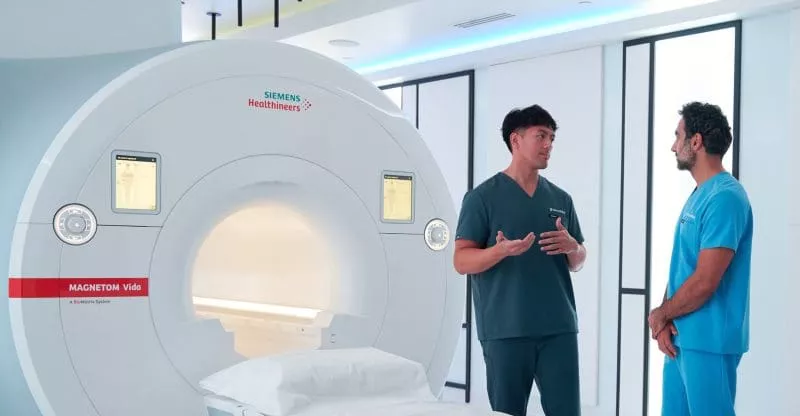
Non-contrast prostate MRI with OnQ analysis and expert radiologist review adds an imaging perspective to PSA, family history and your personal risk.
WHY IT MATTERS
These American Cancer Society estimates show why a thoughtful screening conversation matters. A PSA blood test is useful, but neither an elevated PSA nor a reassuring PSA tells the whole story.[1]
PSA can rise for reasons other than cancer. Some significant cancers occur below commonly used PSA thresholds.
MRI looks for suspicious areas and helps guide whether targeted biopsy or continued monitoring should be discussed.
Localized disease may allow curative surgery or radiation. Selected low-risk cancers can be monitored with active surveillance, avoiding immediate treatment.[6]
2025–2026 RESEARCH
The randomized PROSA trial compared an MRI-first pathway with a pathway that used PSA to decide who received MRI. Among 759 randomized men, clinically significant cancer was found in 4.6% versus 1.8%.[2]
This supports looking beyond a PSA threshold alone. It does not mean every individual’s detection rate doubles, and the study did not test OnQ or demonstrate a reduction in prostate cancer deaths.
PROSA · randomized screening study
Online 2025 · published in European Urology, 2026
The trade-off: biopsies were also more frequent (10.8% versus 5.2%). PROSA was a single-center study with limited follow-up; greater detection must be balanced against extra procedures and overdiagnosis.[2]
WHY NON-CONTRAST MRI
Biparametric MRI combines anatomical images with diffusion imaging, which examines how water moves through tissue. It usually avoids an IV contrast injection.
In the 2025 PRIME trial, non-contrast MRI detected clinically significant cancer in 29.2% of participants versus 29.6% with contrast-enhanced MRI, meeting the study’s noninferiority criterion. The 490 participants already had suspected prostate cancer; these are not screening yields for healthy men.[3]
“Clinically significant” generally refers to Grade Group 2 or higher cancer in these studies. MRI helps assess concern; tissue diagnosis and clinical context determine what a finding means.
ONQ AT SIMONMED
SimonMed uses OnQ Prostate, FDA-cleared post-processing software built on restriction spectrum imaging (RSI). Its quantitative maps highlight restricted diffusion associated with suspicious tissue, adding information to the radiologist’s interpretation.[4]
OnQ processes specialized diffusion data to create restricted-signal maps and a quantitative score.
The radiologist considers the maps with the MRI, PSA information and clinical history. A software score does not diagnose cancer.
A reassuring result may support monitoring; a suspicious result can lead to urology review and consideration of targeted biopsy.
A 2025 multicenter retrospective study included 1,892 patients and supported RSI as a useful quantitative biomarker. Its strongest performance came from combining information, including expert MRI assessment and PSA density. This is promising complementary evidence, not proof that AI replaces radiologists or biopsy.[5]
YOUR EXAM
Share PSA results, family history, previous biopsies and any implants or metal. The team confirms MRI suitability and preparation.
Lie still for a focused MRI. The screening protocol is designed without routine IV contrast; your team confirms the final protocol.
Receive an expert report and discuss whether routine monitoring, urology evaluation or further testing is appropriate.
GOOD TO KNOW
Discuss it with your clinician based on age, PSA pattern, family history, ancestry and preferences. This offer is not a recommendation that every man needs an MRI.
The $150 rate is for the prostate MRI add-on. Bring a recent PSA result; the concierge must confirm whether additional PSA testing is needed and how it is priced.
No. MRI and PSA can both miss cancer. Ongoing screening or biopsy may still be appropriate when clinical suspicion is high.
GO FURTHER, THOUGHTFULLY
CONCIERGE SIMONMED LONGEVITY SCHEDULING
xxx xxx xxxx
Locations nationwide · Exam availability varies by location.
Bundled with your $399 HealthCheck 2.0. Add-ons require clinical suitability and may need more time or a separate appointment.
Plan your visit ↗THE EVIDENCE BEHIND THE EXPLANATION
Sources reviewed September 19, 2026. Study populations and limitations are described above. Educational information complements individualized medical care.
SIMONMED LONGEVITY
Advanced Testing. Results. Plan.
Start with HealthCheck 2.0